📖 1. The Mythological Beginning – The Birth of Maa Kali
The story of Kali Puja begins with the birth of Goddess Kali, who represents the dark, fierce, and protective aspect of the Divine Mother.
🩸 The Battle Between Devas and Asuras
In ancient times, the universe was threatened by a powerful demon named Raktabija.
He had a strange boon — every drop of his blood that fell on the ground would give rise to another demon exactly like him.
When the gods fought him, their weapons only worsened the situation.
Every strike created thousands of Raktabijas. The earth trembled under their might.
Desperate, the gods turned to Goddess Durga (Parvati) for help.
To destroy Raktabija, Durga invoked her fiercest energy — and from her forehead emerged a dark, terrifying form — Maa Kali.
⚔️ 2. The Story of Kali’s Battle
Maa Kali appeared with:
-
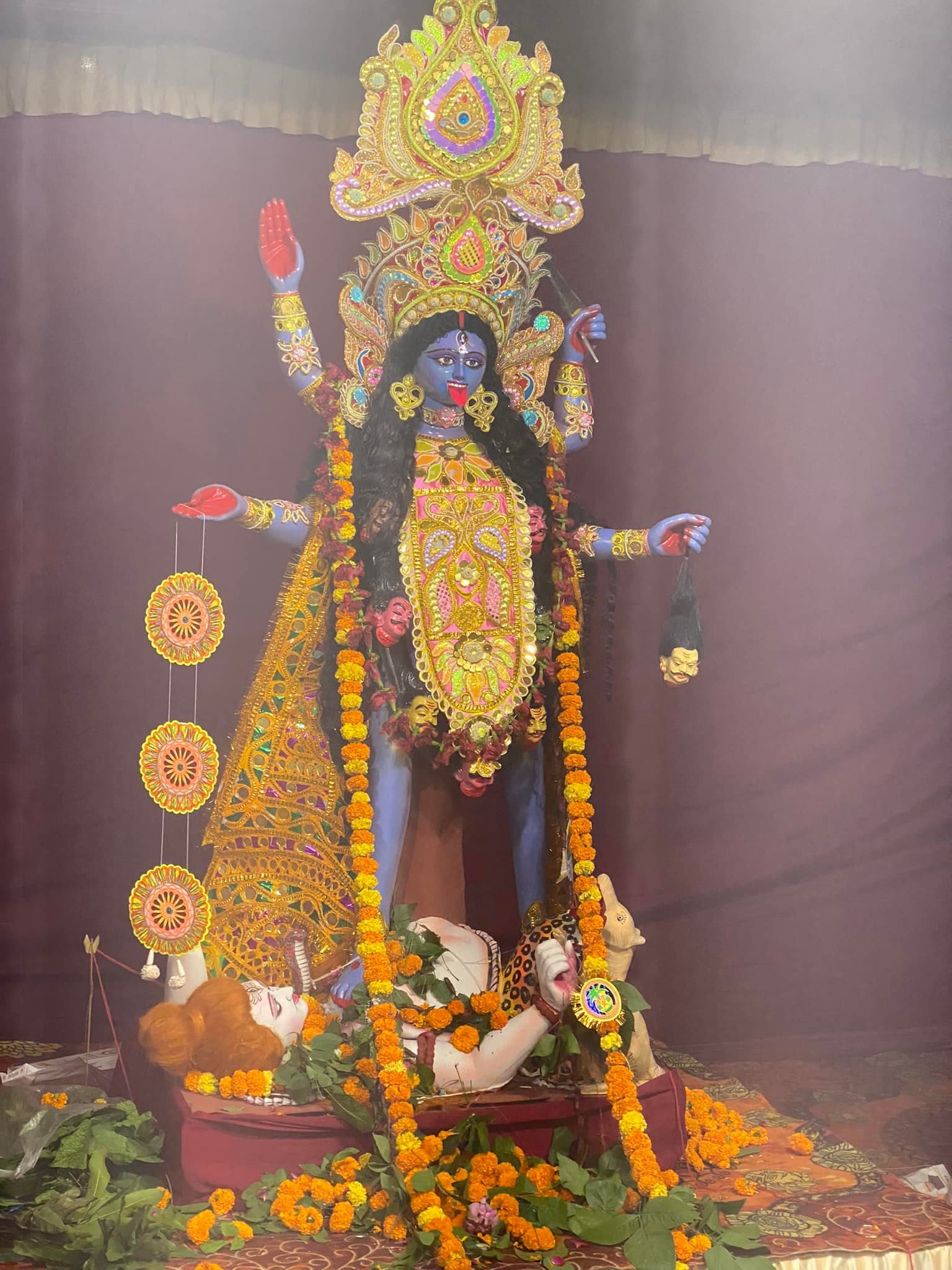
Dark blue/black skin symbolizing infinity
-
Long disheveled hair, symbolizing the wild cosmic power of creation
-
A garland of skulls and skirt of hands representing the destruction of ego and karma
-
Weapons in her ten hands — sword, trident, discus, and more
She roared so loud that the demons shook with fear.
Kali leapt into the battlefield, drinking Raktabija’s blood before it could touch the ground, and swallowed all his clones one by one.
Finally, she destroyed Raktabija completely, restoring peace to heaven and earth.
But after the battle, Kali’s rage didn’t stop.
She continued her dance of destruction (Rudra Tandava), threatening to end the world itself.
To stop her, Lord Shiva, her consort, lay down among the corpses on the battlefield.
When Kali unknowingly stepped on him, she realized her mistake — her tongue came out in shame and she calmed down.
This image — Kali standing on Shiva with her tongue out — became her most worshiped form.
🕉️ 3. Why Kali is Worshipped – The Spiritual Meaning
Kali is not evil or violent — she is the destroyer of evil.
She is the dark mother, who:
-
Destroys ignorance, ego, and negativity
-
Protects devotees from fear and evil influences
-
Grants inner freedom (moksha) and strength
Her black form represents the cosmic void, from which all creation arises and dissolves.
Her fierce face reminds us that truth is not always gentle — sometimes, it shatters illusions to awaken us.
So, Kali Puja is not about fear — it is about courage, transformation, and liberation.
🏮 4. The Historical Beginning of Kali Puja
Though the worship of Kali existed in ancient Tantrik texts, organized public celebration of Kali Puja began in Bengal during the 17th century.
🕰️ Historical Timeline:
-
Pre-Vedic Age: Kali worship existed among early Shakta (Shakti) sects.
-
6th–10th Century: Tantrik texts like Kalika Purana and Devi Mahatmya described her forms.
-
15th Century: Saints like Krishna Chaitanya and Ramakrishna Paramhansa spread devotional Kali worship.
-
17th–18th Century: Kings and landlords (zamindars) in Bengal, like Krishnananda Agamavagisha and Raja Krishnachandra, started community Kali Pujas similar to Durga Puja.
-
Modern Times: Kali Puja became the Bengali equivalent of Diwali, celebrated on Amavasya night (new moon night) of Kartik month.
🎆 5. Why Kali Puja Coincides with Diwali
Across India, Diwali celebrates Goddess Lakshmi, the bringer of light and prosperity.
But in West Bengal, Odisha, and Assam, the same night is dedicated to Maa Kali.
🌑 The Deeper Meaning:
Before welcoming Lakshmi (light), one must remove darkness — the inner ignorance and negativity.
Kali represents that cleansing darkness.
Thus, Bengal celebrates Kali Puja on the Diwali night, symbolizing:
“First remove darkness (Kali), then welcome light (Lakshmi).”
🪔 6. How Kali Puja is Celebrated
🏠 Preparation
-
Homes are cleaned and decorated with alpona (white rangoli) and oil lamps.
-
Families purchase new broom (jharu), haldi (turmeric), and kori shells, believed to invite prosperity and sweep away negativity.
-
Some devotees fast or eat fruits only until midnight puja.
🕯️ The Puja Rituals
-
Installation of Maa Kali’s Idol or Picture
-
Idol placed facing south (her direction).
-
Decorated with red hibiscus, skull garlands, and incense.
-
-
Midnight Puja (Nishita Kaal)
-
The most powerful period — usually between 11:40 PM and 12:30 AM.
-
The priest or devotee performs Tantrik or Vedic rituals, chanting:
“Om Krim Kalikayai Namah”
invoking the goddess into the idol.
-
-
Offerings (Bhog)
-
Red hibiscus flowers, fruits, rice, sweets, and black sesame seeds.
-
In Tantrik tradition, five symbolic elements (panchamakara) are offered secretly, representing the surrender of ego.
-
-
Lighting Diyas and Lamps
-
Mustard oil diyas are lit throughout the house to remove negativity.
-
Firecrackers and lamps illuminate the night — symbolizing victory over darkness.
-
-
Aarti and Chanting
-
Devotees sing Kali Chalisa, 108 names of Kali, and Kali Aarti.
-
Chanting continues late into the night.
-
-
Prasad Distribution
-
Sweets, fruits, and khichuri (rice-lentil meal) are shared after puja.
-
Devotees often visit Kalighat, Dakshineswar, or local temples the next morning.
-
🌸 7. The Legend of Kalighat and the Name “Kolkata”
According to Shakti Peeth mythology, when Sati (Parvati) self-immolated at Daksha’s Yajna, Lord Vishnu cut her body into 51 pieces to calm Shiva’s grief.
-
Her right toe fell at the spot where Kalighat Temple now stands in Kolkata.
-
Hence the region was called Kalikata (the land of Kali), later known as Kolkata.
Kalighat remains one of the most powerful Shakti Peethas, and on Kali Puja night, lakhs of devotees gather there for worship.
🕉️ 8. Spiritual Meaning of Kali Puja
| Symbol | Meaning |
|---|---|
| Amavasya (New Moon) | Represents darkness — the time to face inner fears and purify the soul. |
| Kali’s Black Color | Infinite consciousness; darkness before creation. |
| Her Garland of Skulls | Each skull represents a letter of the Sanskrit alphabet — symbolizing her power of speech and creation. |
| Standing on Shiva | Energy (Shakti) and Consciousness (Shiva) are inseparable. |
| Hibiscus Flower | Symbol of life force and sacrifice — offered to Kali as devotion. |
| Firecrackers & Lamps | Victory of light (knowledge) over darkness (ignorance). |
💫 9. Modern-Day Celebration
Today, Kali Puja is celebrated with grandeur and devotion:
-
Massive pandals and idols are built in Bengal, Assam, and Odisha.
-
Devotees worship her with Tantrik rituals, bhajans, and meditation.
-
Homes glow with diyas, and sweets like sandesh and narkel naru are distributed.
-
Fireworks fill the night sky — symbolizing the light of consciousness breaking the dark ignorance.
At Dakshineswar Temple, Kalighat, and Tarapith, special Tantrik pujas are performed all night.
🌺 10. The True Message of Kali Puja
Kali Puja teaches us:
“To find light, you must first face your darkness.”
Maa Kali destroys what binds us — fear, greed, ego — and replaces it with courage, truth, and divine awareness.
She shows that death is not the end, but a doorway to transformation.
That’s why she is called:
“The Mother of Time, The Destroyer of Illusion, The Liberator of Souls.”