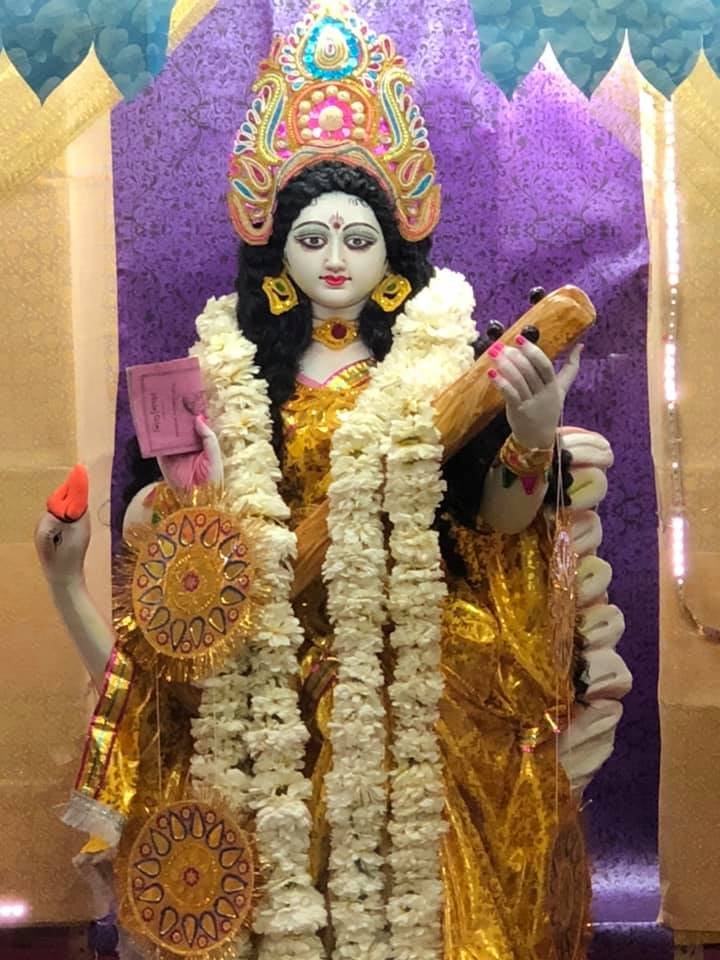
🌼 SARASWATI PUJA — THE COMPLETE STORY, HISTORY & CELEBRATION
📖 1. Who is Goddess Saraswati
Goddess Saraswati is the Hindu goddess of knowledge, wisdom, learning, art, and music.
She is the divine consort of Lord Brahma, the Creator in the Hindu Trinity.
Her name comes from:
“Saras” — flow or essence
“Wati” — the one who possesses
So, Saraswati means “the one who possesses the essence of all wisdom.”
She represents the flow of knowledge, much like a river that nourishes the intellect and the soul.
🌅 2. The Mythological Origin of Goddess Saraswati
🪶 The Creation of the World
According to the Brahma Purana, when Lord Brahma created the universe, it was chaotic and silent — full of matter but without harmony.
Brahma realized the creation lacked expression, form, and melody.
So he created a goddess from his own being — Saraswati, the embodiment of speech (Vāk), music, wisdom, and learning.
When she appeared, she held:
-
A Veena (symbol of rhythm & arts)
-
A book (Veda) (symbol of knowledge)
-
A rosary (Akshamala) (symbol of meditation)
-
And a pot of water (symbol of purity & creativity)
She blessed the world with language, communication, and knowledge.
The moment she played her Veena, the first sound of creation (AUM) vibrated through the universe — bringing order, rhythm, and consciousness to existence.
Thus, Saraswati became the Mother of Knowledge, guiding all beings to enlightenment.
🕉️ 3. The Story of Saraswati and Brahma
Another legend says that when Brahma saw Saraswati, he was so enchanted by her beauty and grace that he desired her as his consort.
He married her to balance his creative energy with wisdom.
Together, they brought harmony between creation (Brahma) and intelligence (Saraswati) — symbolizing that knowledge must guide creation.
🪔 4. Why Saraswati Puja is Celebrated
Saraswati Puja, also called Vasant Panchami, marks the birth of Goddess Saraswati — the day when Brahma created her and she brought wisdom to the world.
It falls on the fifth day (Panchami) of the bright fortnight (Shukla Paksha) in the Hindu month of Magha (January–February).
This day is also the beginning of spring (Basant Ritu) — the season of renewal, creativity, and growth.
Thus, Saraswati Puja is celebrated to:
-
Worship the goddess of learning and wisdom
-
Seek enlightenment and purity of thought
-
Honor the arts, music, and culture
-
Start new phases of education or creative work
🏫 5. Discipline and Rules During Saraswati Puja
Saraswati Puja is a pure and sattvic (spiritually elevated) festival.
It emphasizes discipline, cleanliness, humility, and devotion.
🕊️ Before Puja
-
Bathe early in the morning (preferably before sunrise).
-
Clean the home, study area, and place of worship.
-
Decorate the altar with white or yellow flowers — colors sacred to Saraswati.
-
Wear yellow or white clothes, symbolizing peace and light.
-
Students place their books, pens, and instruments near the goddess’s idol for blessing — this is called Hate Khori or Vidyarambham in Bengal and South India.
🪶 During Puja
-
Do not touch books or read/study until after the puja — it’s believed that knowledge rests in the goddess’s hands during worship.
-
Offer white sweets, fruits, and khichuri.
-
Chant Saraswati Vandana and Saraswati Ashtakshara Mantra:
“Om Aim Saraswatyai Namah”
🍚 After Puja
-
Distribute prasad among students and devotees.
-
Begin reading, writing, or musical practice — symbolizing the renewal of knowledge.
🎶 6. The Myth of “Hate Khori” — The Beginning of Learning
In Bengal, small children are made to write their first letters (অ, আ, ক, খ) on a slate in front of Maa Saraswati’s idol.
This ritual, known as Hate Khori (Hand Initiation), marks the beginning of education in a child’s life.
It is believed that Maa Saraswati herself guides their hand and blesses them with wisdom.
🌼 7. Symbolism of Goddess Saraswati
| Symbol | Meaning |
|---|---|
| Veena | Harmony between thought, word, and action |
| Book (Vedas) | Eternal knowledge & learning |
| White Swan (Hamsa) | Power to discriminate truth from falsehood |
| White Lotus | Wisdom emerging from purity |
| Yellow/White Clothes | Peace, purity, and inner light |
| Four Hands | Mind, intellect, ego, and consciousness |
🕯️ 8. Historical Evolution of Saraswati Puja
-
Vedic Age: Mentioned as Vāk Devi in the Rig Veda — goddess of speech.
-
Puranic Age: Worshiped as Brahma’s consort and source of wisdom.
-
Medieval Bengal: Became the patron goddess of education and music.
-
Modern Era: Celebrated in schools, colleges, homes, and cultural institutions across India — especially in Bengal, Assam, Bihar, Odisha, and southern India.
🎨 9. How Saraswati Puja is Celebrated Today
🌸 In Bengal & Eastern India
-
Idols of Saraswati are installed in homes, schools, and community pandals.
-
Students and teachers perform puja with devotion.
-
Girls wear yellow sarees, and the day becomes a joyful cultural festival with music, art, and poetry.
-
After immersion (Visarjan), students begin a new study phase.
🌾 In North & South India
-
Known as Vasant Panchami, marking the start of spring.
-
Fields are decorated with yellow mustard flowers.
-
People fly kites, wear yellow clothes, and offer prayers for prosperity.
🕊️ 10. The Spiritual Message of Saraswati Puja
Saraswati Puja reminds us that:
“Knowledge is the greatest power — it liberates, not dominates.”
Her calm expression teaches humility before wisdom.
Her white attire symbolizes purity of thought, and her Veena’s melody teaches that life is beautiful when it’s in rhythm with truth and compassion.
💫 11. Key Mantras
Saraswati Vandana:
“Ya Kundendu Tusharahara Dhavala,
Ya Shubhra Vastravrita,
Ya Veena Varadanda Manditakara,
Ya Shveta Padmasana,
Ya Brahmachyuta Shankara Prabhritibhir,
Devaih Sada Vandita,
Sa Maam Paatu Saraswati Bhagavati,
Nihshesha Jadyapaha.”
Meaning:
“O Goddess Saraswati, pure as the snow-white lotus, holding the Veena, adored by all gods — remove ignorance and bless me with wisdom.”
🌺 12. The True Meaning
Saraswati Puja is not just a festival — it’s a prayer to awaken our higher intelligence.
It teaches that knowledge is sacred, and that learning should lead to humility, not pride.
Maa Saraswati represents the light of understanding, guiding humanity from confusion to clarity.
“Where there is Saraswati, there is knowledge.
Where there is knowledge, there is truth.
Where there is truth, there is peace.”